Original-risk R must survive later amendments
Keep the first risk cash amount and distinguish revised-risk reporting, marked exposure and return on capital.
Name the denominator beside the statistic
R expresses a chosen amount divided by a specified risk cash denominator. A statement labelled original-risk R must preserve its initial declared denominator. It is not the same as return on account capital, return on margin or a later revised stop estimate. The lens receives positive entered risk and does not derive appropriate size or guarantee the loss bound. Its default twenty is fictional. An actual record needs the source defining original quantity, entry basis and risk policy, with effective versions and complete economic inclusions.
An amendment is a separate event
A later quantity, stop or risk change can be recorded without replacing the first contract. Retain original plan ID, amendment ID, reason, receiving time and the field changed. A later favourable result must not choose whichever denominator looks best. Native whole-position, minute execution and maximum-hold ownership remain unchanged by a teaching row. The packet contains no actual amendment or order. It demonstrates how labels prevent one statistic being misrepresented as another, not a method for optimising a profitable exit or controlling a live account.
Marked remainder belongs in the numerator
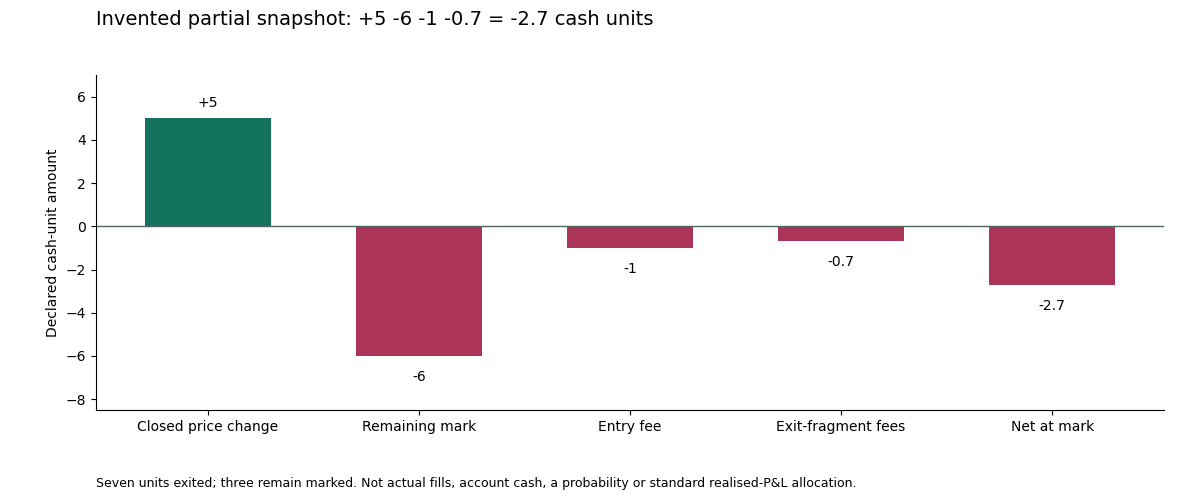
A closed-fragment amount may not describe the complete economic position. The snapshot lens includes remaining price mark and all incurred fee cash under its explicit convention. Neither marked value nor closed-price-less-fees is automatically a broker realised-P&L amount. Finance, borrow, tax and capital movements are excluded. An authentic comparison needs the same numerator inclusion and original denominator throughout the eligible period. A precise R value cannot authenticate that consistency. The original journal's worked risk examples remain available as teaching records, not actual performance sources.
Do not turn a ratio into calibration
The seven amount cases are manually authored and the nine setup classifications have no financial outcome. Their R values cannot create a grade success rate, expected return or probability. Real entry ranking stays on its canonical causal objective before one frozen exit and independent master. Software oracle agreement verifies equations rather than a completed financial experiment. No current account, provider cohort or independent return audit was gathered. The fictional comparison below names the denominator choice without claiming either ratio is a corrected broker result or suitable risk allocation.
Fictional short-horizon evidence case
The same invented net marked amount negative 2.7 divided by original risk twenty is negative 0.135R. Dividing by a later declared ten yields negative 0.27R. The amount did not change; the statistic did. The tool preserves only its entered original-risk label and authenticates no real risk amendment or stop.
| Object | Record | Bounded finding |
|---|---|---|
| Original risk | 20 declared | -0.135R |
| Later alternative | 10 declared | -0.27 under another basis |
| Actual policy | Absent | No max-loss certification |
Primary references and scope
Source review: 14 October 2026. Official mechanism descriptions are not this desk's paid-account test, independently captured fills or vendor-return audit.