Closed-leg cash can hide a short-term open remainder
Reconcile original quantity, unique execution fragments, incurred fees and a declared remaining mark before reporting a completed result.
Start with the original position
Fix original whole quantity and a single entry basis before summing exit fragments. The teaching engine permits two declared legs whose total cannot exceed that original quantity. It does not determine requested order quantity or select a partial-exit strategy. Zero-sized legs contribute no price change and must have zero leg fee. Actual product increments, contract multipliers and broker permissions remain unverified. These are narrow software conventions, not an assertion that a particular account could execute the assumed units or that an original position really existed.
Carry the units that have not closed
Closed price change uses each leg's quantity and price difference from entry, reversed for short. Original quantity less the two legs gives the remaining position. That remainder receives a declared review mark, not a hypothetical closing fill or guaranteed liquidation price. The calculator has no timestamps and cannot establish session completion. Cancelling an unfilled request does not change executed position quantity. Authentic full economic reconciliation requires unique fills, current position, original fee cash and selected valuation policy. A tidy order status alone cannot replace those sources.
Specify the fee allocation convention
All entered incurred entry and exit fee cash is subtracted in the snapshot. The closed-price-less-all-fees amount is intentionally not labelled standard broker realised P&L; the full entry fee is not prorated to closed quantity. Total at the mark adds remaining price change before those same fees. No second spread/slippage charge is applied to price differences already represented by the entered execution assumptions. Borrow, financing, tax and margin are excluded. A real statement can use another allocation policy and needs its actual sources rather than these fictional totals.
Keep interpretation narrower than precision
A frozen original-risk denominator provides a labelled teaching R amount, not return on capital or a maximum-loss guarantee. Decimal.js and an independent Python Decimal oracle check arithmetic only. The cases contain no real price, fill or account. Their positive and adverse branches do not estimate a distribution. Actual strategy validation and production ownership remain separate evidence classes. A user-triggered JSON preserves exact inputs and false authenticated identity, so a calculator's complete record cannot quietly become an independently audited subscriber result or a personally suitable position.
Fictional short-horizon evidence case
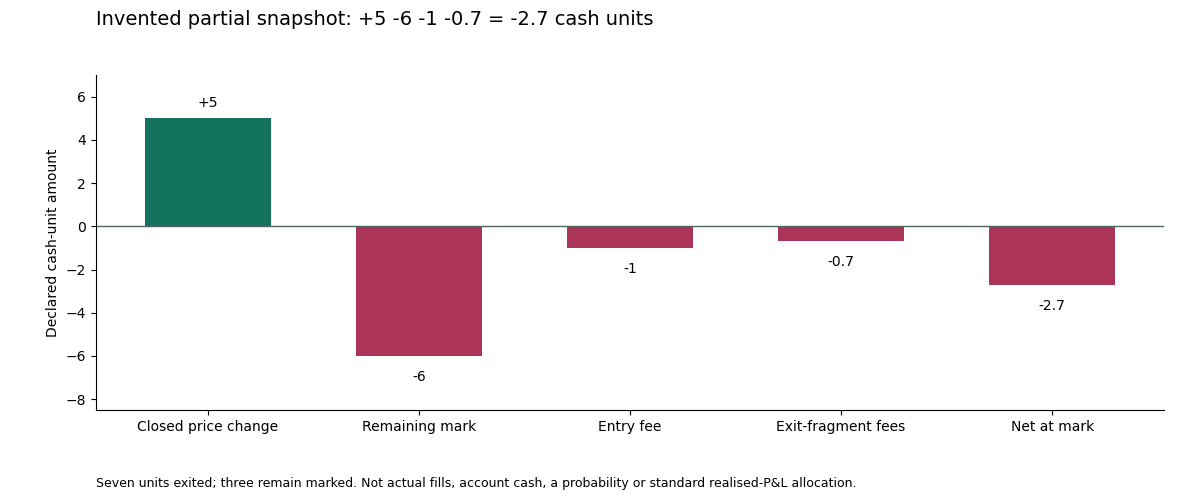
Invented ten units at 100: four exit at 102 and three at 99, leaving three marked at 98. Closed price change is five; open mark change is negative six; incurred fees are 1.7. Total is negative 2.7, or negative 0.135R on original risk twenty. Closed price less all fees is positive 3.3, not full position closure.
| Object | Record | Bounded finding |
|---|---|---|
| Closed price | +5 cash units | Declared fragments |
| Remaining mark | -6 cash units | Not liquidated |
| Net snapshot | -2.7 / -0.135R | Original risk twenty |
Primary references and scope
Source review: 14 October 2026. Official mechanism descriptions are not this desk's paid-account test, independently captured fills or vendor-return audit.