Short-Term Trades Across Session and Calendar Boundaries
Map market sessions, data bars, order validity and overnight exposure instead of assuming a local calendar day defines the trading process.
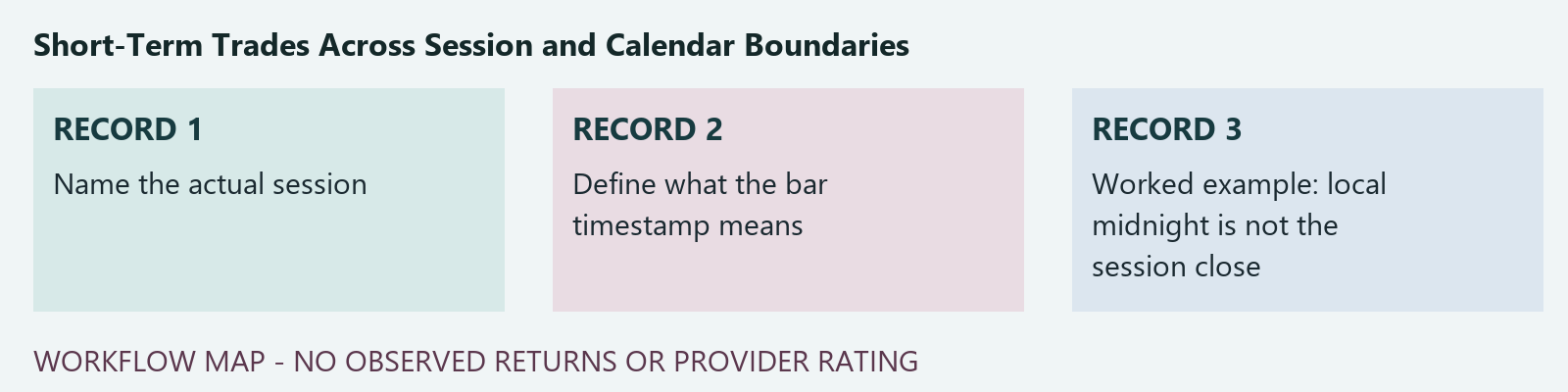
Name the actual session
Record exchange or venue, product calendar, session opening and closing, holidays and the applicable time zone. A local date is not necessarily the venue's trade date. Daylight-saving transitions can change the mapping between two clocks. Use a dated calendar source rather than a fixed offset remembered from last month. This chapter does not publish a current trading schedule; it explains the fields needed to interpret the schedule for the exact instrument and account.
Define what the bar timestamp means
A bar can be stamped by opening time, closing time or another vendor convention. Identify the interval, when its completed values became available and whether gaps or partial sessions produce shortened bars. A signal using the final high or close cannot be reconstructed as though those values were known at the interval start. Retain source revisions and late observations separately. Time-aware evaluation references help frame the data question, but the vendor and venue records are required to answer it.
Worked example: local midnight is not the session close
Invent a venue session running from 22:00 to 06:00 in its declared clock. A position opened at 23:00 and closed at 02:00 crosses a calendar date while remaining in one invented session. Calling it automatically a two-day trade would use the wrong boundary. Another account rule might still reset at midnight, creating a separate funding or evaluation event. The fixture demonstrates clock mapping, not a real venue timetable. Keep session identity and account-rule clock in different columns rather than forcing them to agree.
Check order validity independently
Record time-in-force, expiry, accepted state and the broker's policy around session transitions. A provider saying same-session exit does not show an order was cancelled or a position closed. Preserve cancellation requests and acknowledgements; a partial fill leaves exposure which an unfilled-order label can hide. SEC order materials explain general instruction mechanisms, while the account's specific implementation controls the actual state. Do not infer execution from the disappearance of an order on an unrelated provider display.
Keep overnight economics visible
Charges, financing, margin changes and market gaps can use clocks different from the analytical signal. Identify which boundaries matter for the product rather than assuming every short holding period avoids them. Retain open positions at each reporting boundary and distinguish planned exit from observed close. A session summary omitting open exposure can look better than the account experience. A hypothetical replay should disclose its treatment of unavailable observations and ambiguous intrabar paths instead of selecting favourable sequencing.
Produce a boundary-aware journal
Join signal time, information availability, session ID, order events and account-rule clocks for every reviewed instruction. Save the calendar version and explain any unresolved time conversion. A consistent time table does not establish profitability or independently validate a short-term strategy; it makes the study and account record intelligible. This guide supplies a journal design and invented example, not a paid service test. The practical improvement is fewer hidden assumptions about what a day, completed bar or same-session result actually means.
Decision record
| Question | Record to retain | Decision boundary |
|---|---|---|
| Session | Product calendar, venue time zone and version | Local date is not necessarily trade date |
| Bar | Interval meaning and availability time | Final bar values are not known at its opening |
| Order | Expiry and broker acknowledgement events | Provider language does not establish closure |
| Account clock | Funding and evaluation reset policy | A session boundary and account reset can differ |
Blank working record
The worksheet contains column headings only. Enter your own dated observations, keep absent evidence marked unknown, and do not treat the file as certification.
 Download worksheet (CSV)
Primary references
- scikit-learn: cross-validation and temporal data
- SEC: order types and execution limitations
- CME: performance bonds and margin
These documents support mechanisms and source definitions, not a tested trading result or a recommendation. Accessed 9 October 2026. The decision workflow and invented examples above are editorial exercises.
Keep reading
Publication methodology | Working glossary | Source and correction policy
A boundary also needs the remaining-position object
Attach original intended quantity, unique executed fragments, cancelled request remainder and actual current position to a real boundary record. A prompt message and a partial fill do not necessarily close the entire position before the deadline. The complete invented event specimen and amount packet preserve that distinction with three units still open after remainder cancellation. They do not create a real source timestamp, revised exit policy or subscriber account. The original boundary worksheet remains unchanged as the place to record authentic session/date ownership and gaps.